 THE GLOWNIQUE
What is LED neon flex, and how does it work?
LED neon flex is a continuous line of LEDs inside a flexible jacket of silicone or PVC. The jacket diffuses the light so the line glows like a tube of glass neon, but there is no neon gas inside; the sign industry sells it as a neon replacement, sometimes called faux neon[1][2][3].
Makers diffuse the light in different ways: one sign-industry range uses a two-colour silicone extrusion, while another pairs its LEDs with a separate light guide[2][1].
Usually the LEDs are small surface-mount (SMD) chips on a flexible circuit, running on low-voltage direct current from a separate power supply, or driver, which converts mains AC[1][4][5]. Sign-industry lines commonly run at 24V, and 12V lines exist too[1][5]. The Glownique's signs run at 12V from a plug-in adaptor.
What is an LED neon sign made of?
A finished Glownique sign has five parts:
- LED neon
- Flexible silicone LED neon, hand-bent to trace every letter and curve of your design.
- Backboard
- Cast acrylic in clear, frosted or a colour, laser-cut to a square, to the shape of the design or around each letter.
- Wiring
- Soldered connections and concealed, cable-managed wiring, so the lit sign seems to float.
- Power supply
- A low-voltage 12V plug-and-play adaptor, supplied for your country.
- Mounting hardware
- Wall standoffs for the pre-drilled backboard, or a hanging kit, so the sign arrives ready to hang.
Cast acrylic is made one sheet at a time between glass plates rather than extruded continuously[6]. One major acrylic maker puts it at about half the weight of glass, with 10 to 20 times the impact strength of ordinary plate glass. It can still break, though into large pieces rather than sharp shards, it scratches more easily than glass, and many glass cleaners are unsuitable for it[7].
Sizes, colours and the full specification are on our custom LED neon signs page.
How are LED neon signs made, step by step?
Every sign is made to order, whether it is a name for a bedroom wall or one of our logo neon signs for business. From first message to crate, this is the process:
- Send your brief. Share whatever you have: a logo file, a font idea, brand colours or a rough sketch, as AI, SVG, PDF, PNG or a photo. Tell us about the wall space and whether the sign will hang indoors or out, and we'll advise on the sign type and size. Indoor is standard and an outdoor build is available; our guide to indoor vs outdoor signs explains the difference.
- Get your free design mockup. A true-to-scale digital proof shows the exact dimensions, colours, backboard cutlines and how the sign will look lit. Our sign size guide helps you choose a size.
- Approve your quote. Your quote comes through WhatsApp and covers the sign, its mounting hardware and tracked shipping, so the shipping cost is confirmed before you pay.
- Pay through Etsy. You pay only once you've approved your design, through our Etsy shop, where eligible orders are covered by Etsy Purchase Protection. Handcrafting begins once payment is confirmed.
- Build it in the workshop. We map the tubing path, laser-cut the backboard, hand-bend the neon, mount it, solder every connection and conceal the wiring. The table below explains each step.
- Test it. Every sign is bench-tested and runs a continuous 24-hour burn-in, explained below.
- Pack and ship it. Cradled in high-density foam inside a timber crate, with its 12V adaptor for your country and the mounting hardware, the sign goes out with tracked delivery worldwide. Our shipping page has the details.
| Step | What happens | Why it matters |
|---|---|---|
| Map the tubing path | Plan the neon's route through every letter and curve of your artwork. | LED neon can be cut only at its maker's marked cut points and bent no tighter than its minimum radius[1][2], so the route is planned before anything is bent. |
| Laser-cut the backboard | Cut the acrylic to a square, to the outline of the design or around each letter. | The cut sets the character of the sign, from a clean panel that frames the glow to letters that look painted onto the wall. |
| Hand-bend and mount | Shape flexible 12V silicone LED neon by hand along the route, then mount it on the backboard. | It is how each sign is built to your exact words, size and colour, rather than mass-produced. |
| Solder and wire | Solder every connection, then conceal and manage the cabling. | Connections are a common failure point in LED systems[8][9]; concealed cabling keeps the floating look. |
Which backboard cut suits your sign?
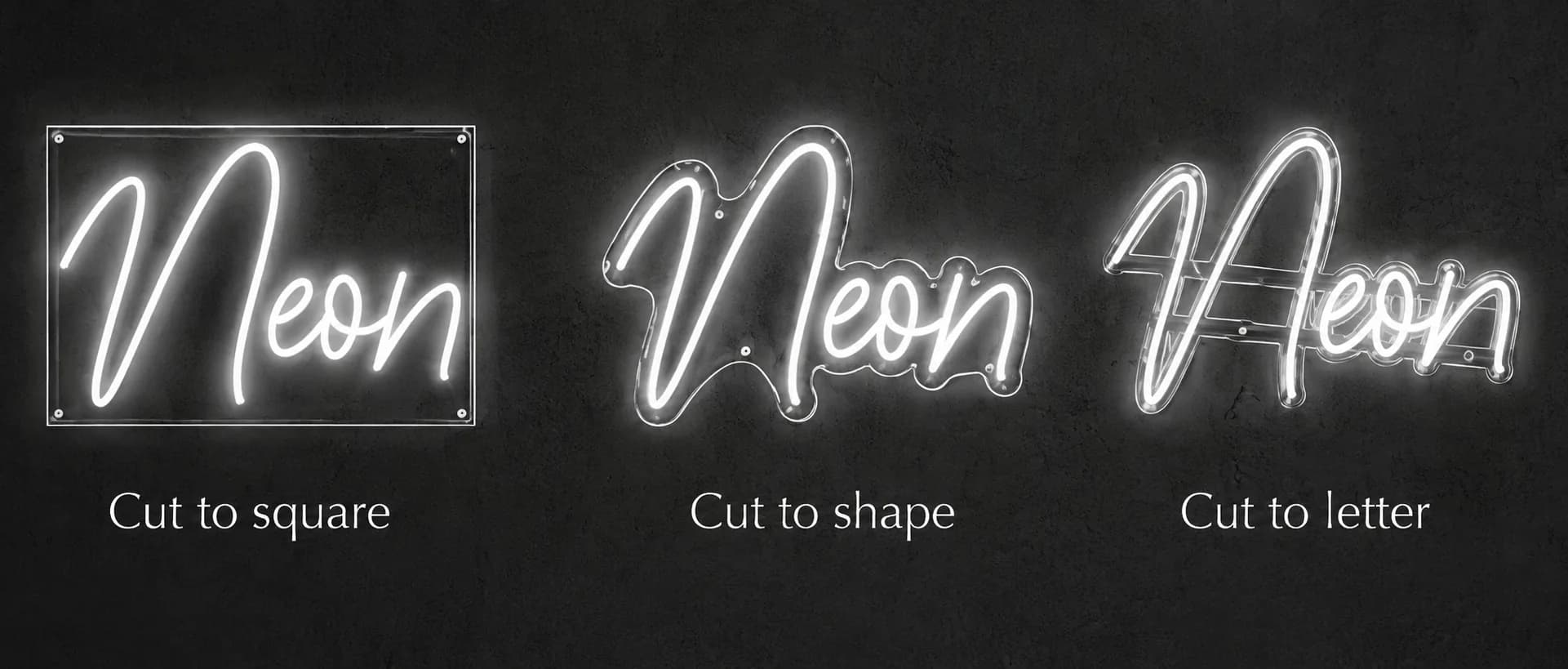
Every sign sits on a laser-cut acrylic backboard, and the cut changes the whole character of the piece. There are three.
| Cut | What you see | Best for |
|---|---|---|
| Cut to square | A clean rectangular panel behind the whole sign: the strongest build and the kindest on price. Clear acrylic reads as a faint edge once lit; frosted or coloured acrylic becomes part of the design. | Block fonts, large signs and tighter budgets |
| Cut to shape | One continuous piece following the outline of the whole design: most of the floating look, in a single sturdy panel that is easier to hang straight and travels in one piece. | Phrases, multi-word signs and larger pieces |
| Cut to letter | Acrylic cut around every letter with only a few millimetres of border, so the backboard all but disappears and the words read as light on the wall. The most intricate cut. | Script, signatures and logos |
Not sure which suits your design? The free mockup can show it all three ways.
What colours can an LED neon sign be?
We make LED neon in 13 solid colours: warm white, cold white, light yellow, yellow, orange, red, light pink, hot pink, purple, dark blue, ice blue, teal and green. Or choose RGB colour-change and add an RGB controller to switch shades, dim, pulse or flash at the touch of a button.
Some LED neon colours come from coloured LEDs, others from white LEDs behind a colour-matched silicone jacket, and the method affects efficiency and colour consistency[2]. Your mockup shows the design lit, in your chosen colours, before you order.
For a detailed, multi-colour logo, our UV-printed acrylic signs print the artwork in full colour onto the acrylic with a UV flatbed, and LED neon lights the contours and key elements.
How is each sign tested before it's packed?
Every sign is built on long-life LEDs and electrically tested before it leaves the workshop. It is bench-tested for an even, flicker-free glow and runs a continuous 24-hour burn-in that checks its electrics and brightness. Only then is it packed.
A burn-in is not a lifetime test
It shows the sign working, lit, for a full day. LED life ratings measure something else: gradual dimming. LEDs rarely fail outright, and a rating such as L70 marks the point at which light output has fallen to 70% of new[8]. Such ratings are projected from lab measurements of the LED packages and cover dimming only[8][10]. A complete LED system cannot be rated to outlast any of its parts[8], and in accelerated tests by an industry reliability consortium working with the US Department of Energy, failures typically occurred in the driver circuit, while fewer than 1% of the LEDs failed[9].
Can you make your own LED neon sign?
Yes. LED neon flex can be cut and formed on site, and sign shops report it is easier to install and service[4][3]. A DIY build comes down to four things:
- Cut only at the marked cut points. Each product has cut points set by its maker, and the spacing varies: 3 inches on one sign-industry line, 100 mm on another, about 500 mm on a mains-voltage product[1][2][11].
- Stay within the bend limit. Every product has a minimum bend radius or diameter, such as a 60 mm radius on one strip and a 90 mm diameter on another, and that sets the tightest curve your lettering can take[2][5].
- Make and seal every connection. Each cut leaves an end to connect and seal; makers use silicone end caps and silicone adhesive[2][4]. Connections, power supplies and moisture getting in are common failure points in LED systems[8][9]. In our workshop, every connection is soldered.
- Match the power supply. The strip needs a separate supply that converts mains AC to the low-voltage DC it is built for, commonly 24V in sign products and sometimes 12V[1][2][5]. How long a run one supply can feed is limited by its load and by voltage drop; one maker allows up to 7.3 metres per 96-watt supply[2]. And not all LED neon is low voltage: some runs directly on 120V mains[11].
Those are the rules of the material, not a wiring guide: work to the datasheet for the exact product you buy. And if it is the finished sign you want rather than the project, send us the design; the mockup is free.
How is glass neon made differently?
Glass neon is a different craft. A skilled glass bender shapes hot glass tubing by hand; the tube, with an electrode at each end, is purified by heating the glass and electrodes to burn off impurities, then evacuated and filled with neon or argon gas[12]. It glows when high voltage drives current through the gas, and US neon transformers typically deliver 1,000 to 15,000 volts[12][13]. Neon gas glows red and mercury-argon glows blue; other colours come from coloured glass and phosphor coatings inside the tube[12][14].
LED neon has no glass tubes to break[4][3], and a Glownique sign has no gas and no high-voltage transformer. Glass neon has strengths of its own: the gas does not wear out, and the US National Park Service puts a typical neon sign's life at 20 to 25 years[12]. Our LED neon vs glass neon guide compares the two in full.
Common questions
Do LED neon signs burn out?
Rarely all at once. LEDs usually dim gradually rather than fail outright, which is why LED life is rated by the light that remains: L70 is the point at which output has fallen to 70% of new. In LED systems generally, the driver in the power supply fails more often than the LEDs themselves.
How can you tell LED neon from glass neon?
Look at the tube and what powers it. Glass neon is rigid glass tubing with an electrode at each end, run from a high-voltage transformer. LED neon is a flexible silicone or PVC jacket over a line of LEDs, run from a separate low-voltage power supply; on our signs, that is a 12V plug-in adaptor.
Can you turn my logo or handwriting into LED neon?
Yes. Send your logo, your wording or a sketch; a signature or a line of handwriting works too. We trace it in LED neon in the colour and size you choose, and you see it first as a free, true-to-scale mockup.
How big can a custom LED neon sign be?
Sizes are fully custom, from about 30 cm up to several metres. The mockup is drawn true to scale with the exact dimensions, so you can check the size against your wall before you order.
Can an LED neon sign be used outdoors?
Yes, as an outdoor build. Indoor is our standard construction and an outdoor build is available, so tell us where the sign will hang when you send your brief.
Do you install the sign, or do I hang it myself?
The Glownique does not install. Each sign arrives ready to hang, with wall standoffs for its pre-drilled backboard or a hanging kit, and plugs in through its 12V adaptor, so you can hang it yourself or have someone do it for you.
See your design in neon before it is made
Send your words, logo or a sketch. Your free mockup shows it true to scale, lit, in your colours and on the backboard cut you choose, before you order.
Keep reading
- LED neon vs glass neon
How the two technologies compare, side by side.
- Indoor vs outdoor illuminated signs
What changes when an illuminated sign has to hang outside.
- Sign size and viewing distance
How big a sign needs to be for the space and the distance it is read from.
- Logo neon signs for business
Your business logo in LED neon, with a free mockup before you order.
Sources
- Tetra Contour Gen 2 Spec Sheet (SIGN309, Rev 11/07/24) — Current Lighting Solutions. Accessed 24 September 2026.
- Street Wrap Flex Side-Bend Spec Sheet (Rev B) — SloanLED (2025). Accessed 24 September 2026.
- Neon vs. LED: Which Is Better Where? — Signs of the Times, R. Roenker (2023). Accessed 24 September 2026.
- Tetra LED Signage Lighting Systems Catalog 2024 (SIGN120) — Current Lighting Solutions. Accessed 24 September 2026.
- Vivid Contour Silicone 12V Static specification (v6.0) — GLLS (2022). Accessed 24 September 2026.
- What is the difference between cast and extruded acrylic sheet? — ACRYLITE knowledge base. Accessed 24 September 2026.
- Acrylic vs Glass — ACRYLITE knowledge base. Accessed 24 September 2026.
- Lifetime and Reliability (SSL fact sheet, PNNL-SA-97534) — U.S. Department of Energy / PNNL (2013). Accessed 24 September 2026.
- LED Luminaire Lifetime: Recommendations for Testing and Reporting, 3rd ed. — NGLIA LED Systems Reliability Consortium / U.S. Department of Energy (2014). Accessed 24 September 2026.
- IES TM-21-11 Overview, History and Q&A — C. Miller, NIST, for EPA ENERGY STAR (2011). Accessed 24 September 2026.
- Vivid S160 PVC 120V UL2388 Static specification — GLLS. Accessed 24 September 2026.
- Preservation Brief 25: The Preservation of Historic Signs — National Park Service, M. J. Auer. Accessed 24 September 2026.
- Determining Proper Loading for Neon Sign Transformers — IAEI Magazine (2000). Accessed 24 September 2026.
- Mercury Lamp Handling & Disposal — International Sign Association. Accessed 24 September 2026.