 THE GLOWNIQUE
Storefront Signage Ideas: 5 Types Compared for Small Businesses
The right storefront signage depends on viewing distance, trading hours, the building surface and whether the message must change. This guide compares channel letters, lightboxes, acrylic signs, LED neon and hybrid systems so a small business can shortlist the right format before requesting a mockup.
Key takeaways
- Choose the sign around its main job—long-distance identification, close-range wayfinding, changeable information or after-dark atmosphere.
- Channel letters suit permanent façade identity, while lightboxes are stronger when graphics or messages need to change.
- Acrylic reproduces detailed branding cleanly, and LED neon works best as a window or interior focal point rather than a long exterior message.
- Test size, angle, location, luminance and contrast from the customer’s real approach before approving final artwork.
- Confirm permits, landlord approval, mounting, power and installation responsibilities before fabrication begins.
The best storefront signage for a small business is the sign that stays legible at the distance customers actually see it, works in both the available daylight and the hours you trade, and can be mounted legally on the building you have. Channel letters are strong permanent façade identifiers; lightboxes suit changeable graphics; acrylic lettering creates a clean daytime identity; LED neon works best as a window or interior focal point; and a hybrid system can combine those jobs.
Choose the format only after checking the viewing route, wall material, power location, landlord rules and local sign code. A beautiful sign that is too small, hidden by an awning or impossible to permit is an expensive decoration rather than a useful storefront asset.
Start with the job your storefront sign must do
A storefront usually asks one sign to do several jobs: identify the business, stay readable while people are moving, look credible in daylight, remain visible after dark and express the brand. Decide which job is essential before discussing materials.
- Identify the business from across a road or parking area.
- Help pedestrians find the correct door or unit.
- Communicate a promotion, menu or message that changes.
- Create a memorable window or photo moment after dark.
The primary building sign should solve identification first. Smaller window graphics, neon accents and promotional lightboxes can then support it without forcing one object to carry every message.
Five storefront signage ideas compared
Use this table as a first-pass shortlist. The right choice still depends on the façade, local rules and the installer’s site assessment.
| Sign type | Best suited to | Daytime visibility | After-dark visibility | Main constraint |
|---|---|---|---|---|
| Front-lit channel letters | Permanent building identity | Strong | Strong | Needs approved mounting, power and installation plan |
| Halo-lit channel letters | Premium façades and reception walls | Strong | Soft architectural glow | Needs a suitable wall surface and spacing behind each letter |
| Edge-lit lightbox | Menus, posters and changeable retail graphics | Strong | Strong | Graphic size and replacement format must be planned |
| Acrylic or dimensional logo | Sheltered entrances, doors and reception areas | Strong | Limited unless separately illuminated | Can disappear after dark without nearby lighting |
| LED neon logo or phrase | Windows, hospitality and brand accents | Moderate | Strong | Glare, placement and message length need control |
Relative visibility assumes appropriate scale, contrast and placement. Site conditions can change the result.
1. Channel letters for a permanent façade identity
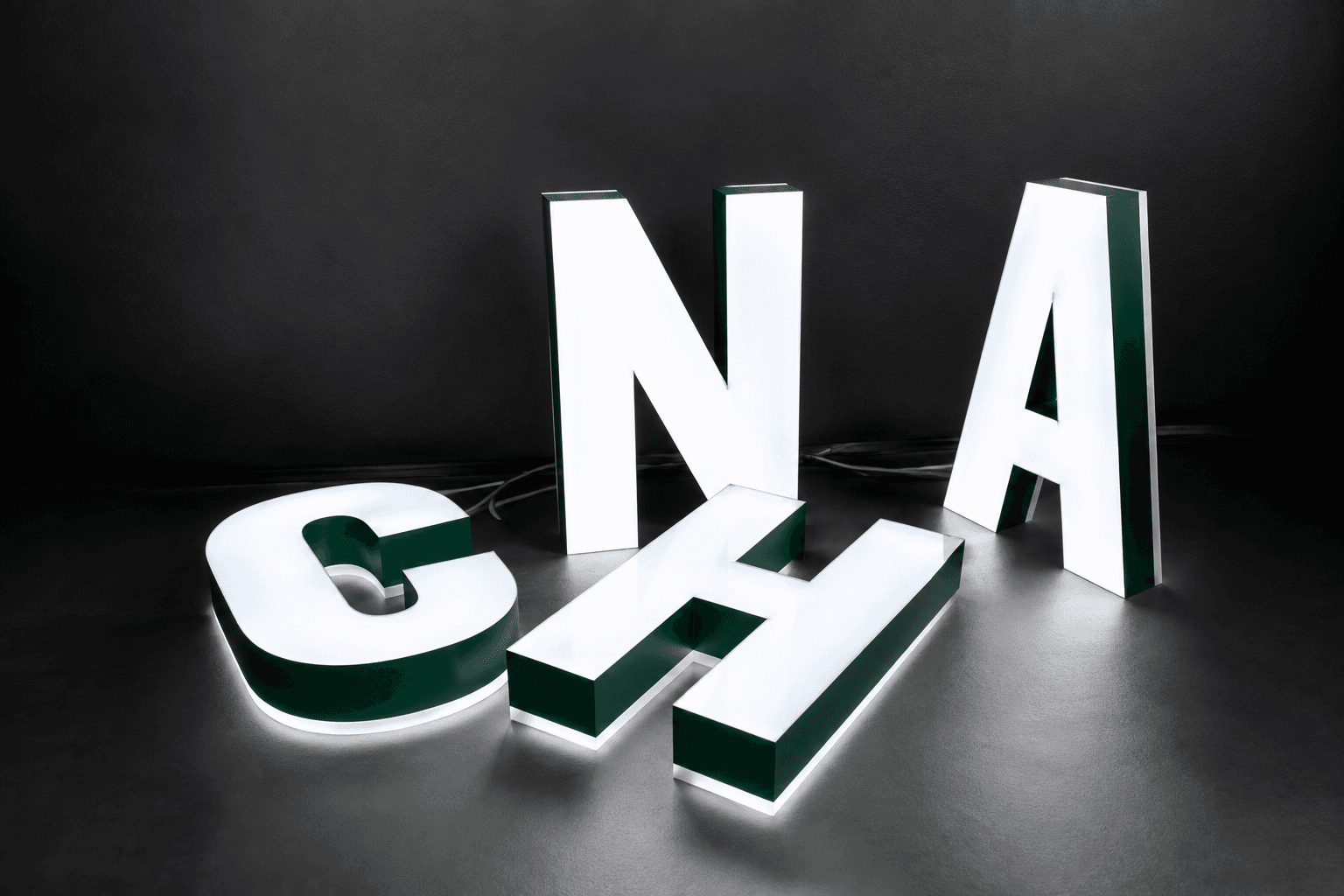
Channel letters turn a name or logo into separate dimensional characters. Front-lit faces give the most direct nighttime readability, halo-lit letters cast a softer glow onto the wall, and dual-lit letters combine both effects. See the channel letter signage page for the available construction and lighting styles.
This format suits a business that expects to keep the same name and location for years. If the choice between front, halo and dual illumination is unclear, use the front-lit versus halo-lit guide before approving artwork.
2. Lightboxes for messages that need to change
A slim lightbox is useful when the illuminated face is a menu, campaign graphic, price panel or seasonal visual rather than a permanent set of letters. The commercial lightbox range uses replaceable graphics, so the frame can remain while the message changes.
Place a lightbox where customers can pause long enough to read it. A detailed menu beside an entrance can work well; the same amount of information high on a roadside façade will not.
3. Acrylic and dimensional logos for clean daytime branding
Acrylic signs reproduce detailed colour, layered shapes and fine logo elements more easily than bent illuminated tubing. They suit sheltered storefronts, entry walls and reception areas where close-range finish matters. Review the acrylic logo sign options when the brand contains gradients, small subtext or multiple colours.
4. LED neon for windows and brand moments
LED neon is effective when the goal is atmosphere, a recognizable phrase or a glowing logo visible through glass. It is particularly useful for cafés, salons, bars and studios, but a long slogan is rarely a good substitute for a concise primary storefront name. The custom logo neon page explains how logos are simplified into workable illuminated paths.
5. A hybrid system when one sign cannot do every job
Many strong storefronts use two layers: a permanent exterior identifier and a smaller message inside the window. For example, channel letters can carry the business name while a neon phrase or lightbox promotes the current offer. Keeping those jobs separate makes each sign easier to read and easier to update.
Size and placement matter as much as the sign type
The International Sign Association identifies five core visibility factors: size, sign angle, location, luminance and contrast. Its sign-effectiveness guidance is a useful reminder that a premium material cannot rescue weak placement.
Photograph the approach from the direction customers travel, not only from directly in front of the building. Note trees, parked vehicles, awnings, neighbouring signs and glazing reflections. Then test the proposed letter height and contrast on the photograph before requesting a final mockup.
What changes the cost of storefront signage
Storefront signage is quoted as a project because the cost is shaped by more than the face of the sign. The custom business sign cost guide explains the main variables without pretending that one price fits every façade.
- Overall width, letter height and the number of individually fabricated elements.
- Metal finish, acrylic thickness, illumination style and weather requirements.
- Power supplies, raceways, cable routes and any required listed components.
- Packing, shipping and access equipment needed at the destination.
- Local permits, landlord approvals, installation and electrical connection.
Ask for an itemized scope that separates fabrication and delivery from permits, access equipment, installation and electrical work. That makes competing quotes easier to compare and exposes responsibilities before production starts.
A practical storefront-sign selection path
- Choose channel letters when the main requirement is a permanent business name readable from a road, car park or opposite pavement.
- Choose a lightbox when the illuminated content is a menu, campaign or graphic that will change.
- Choose acrylic or dimensional lettering when close-range finish and detailed brand reproduction matter more than nighttime glow.
- Choose LED neon when the sign sits in a window or interior and needs to create atmosphere or a memorable brand moment.
- Choose a hybrid system when the exterior must identify the business and the window must communicate something different.
What to send for an accurate storefront mockup
A useful mockup begins with site information, not only a logo file. Send the following before asking a designer to recommend dimensions:
- A straight-on wall photograph and one photo from the customer approach.
- Measured wall width, available height and the position of doors, windows and awnings.
- The vector logo file, brand colours and the shortest approved business name.
- Typical viewing distance and whether most customers arrive on foot or by vehicle.
- Trading hours, nearby lighting and whether nighttime visibility is essential.
- Known landlord, planning, weatherproofing, installation or power constraints.
Final checklist before approving a storefront sign
- The business name is readable at the real viewing distance.
- The sign remains distinguishable from neighbouring façades in daylight.
- The nighttime lighting method matches the hours and mood of the business.
- The mounting surface, power route and installer responsibilities are documented.
- The landlord and local authority requirements have been checked.
- The quote states what is included for fabrication, delivery, installation and electrical work.
Frequently asked questions
- What is the best type of storefront signage for a small business?
- For a permanent building identity, channel letters are usually the strongest starting point. Choose a lightbox for changeable graphics, acrylic for detailed close-range branding, or LED neon for a window or interior brand accent. The best option depends on viewing distance, trading hours, the façade and local rules.
- Do I need a permit for storefront signage?
- Many communities require a permit for a new storefront sign, and some also regulate temporary signs or banners. Requirements vary by jurisdiction, building and sign type, so confirm the local sign code and landlord approval before final dimensions are approved.
- How much does storefront signage cost?
- The price depends on size, materials, illumination, finish, weather requirements, shipping, mounting, permits and installation. Request an itemized project quote that separates fabrication and delivery from local installation, access equipment and electrical work.
- Should a storefront sign be illuminated?
- Illumination is useful when the business trades after dark or needs to remain visible from a distance. A daytime-only shop with strong exterior lighting may use non-illuminated dimensional lettering, while evening businesses often benefit from channel letters, a lightbox or a controlled neon accent.
- Which storefront sign works well in both daylight and at night?
- Front-lit or dual-lit channel letters and well-designed lightboxes can remain clear in daylight and illuminated after dark. Their effectiveness still depends on scale, contrast, placement and the surrounding light level.
Sources
- Five factors that affect sign visibility and effectiveness — International Sign Association (accessed 25 August 2026)
- Storefront sign permits, local code review and variance guidance — International Sign Association (accessed 25 August 2026)
- Safety standards and certification considerations for electric signs and components — UL Solutions (accessed 25 August 2026)
Turn the idea into a sign
Send us your logo, words or a rough sketch and we'll come back with a free digital mockup and a quote for your exact size — before anything is built.